Is Your Resume Ready for 2026?
Vocabulary
Applicant Tracking System (ATS) – Software used to scan and filter resumes before a person ever reviews them.
Example – Many large companies rely on an Applicant Tracking System to manage hundreds of applications at once.
Optimize – To change something so it works as effectively as possible.
Example – She optimized her resume by matching the exact wording used in the job posting.
Quantify – To describe something using specific numbers or measurable results.
Example – Instead of saying he “improved sales,” he quantified the result: a 22% increase in six months.
Buzzword – A fashionable word or phrase that sounds impressive but often carries little real meaning.
Example – Recruiters are tired of buzzwords like “team player” that appear on almost every resume.
Disclose – To reveal or share information that was previously private or unknown.
Example – Some experts believe candidates should disclose when they have used AI to help write their resume.
Article
A resume used to be something you wrote once, printed, and updated only occasionally. In 2026, that approach no longer works. Hiring has become more competitive and far more automated, and a resume now has to satisfy both software and human judgment before it earns an interview.
The Machine Reads It First
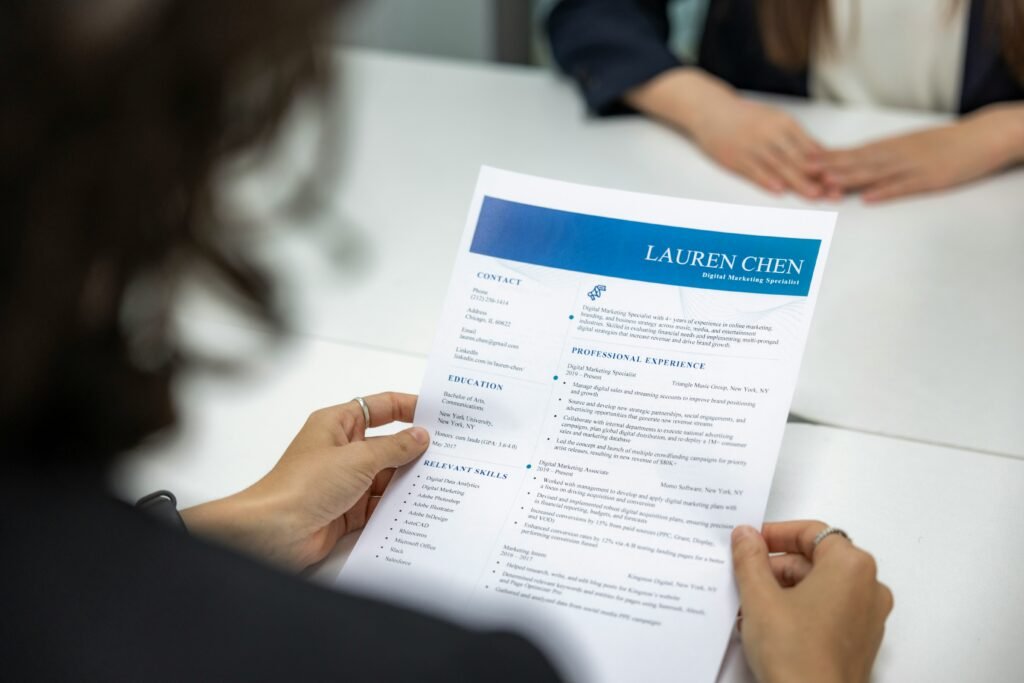
According to research from Jobscan, a platform specializing in resume optimization, an estimated 98% of Fortune 500 companies now use an Applicant Tracking System to scan resumes before a recruiter ever sees them. These systems look for keywords and phrasing that match the job posting closely, which is why simple synonyms are often not enough. Jobscan’s 2026 data found that candidates who include the exact job title from the posting on their resume are roughly 10.6 times more likely to get an interview than those who don’t. Formatting matters here too: a single-column layout with standard section headings performs far better than a resume with graphics or multiple columns, since ATS software often cannot read them correctly.
Evidence Over Adjectives
Once a resume passes the ATS stage, a human reader is judging it very differently. Monster’s 2026 Resume Trends report describes a clear shift away from simply listing responsibilities toward proving measurable impact. Recruiters increasingly expect specifics: not “managed a sales team,” but “led a team of 12 sales representatives and increased quarterly revenue by 18%.” Numbers give an employer something concrete to evaluate, and they are far more persuasive than adjectives like “hardworking” or “motivated,” which appear on nearly every resume and, according to Monster, now carry almost no weight with recruiters.
The AI Paradox
Artificial intelligence has become part of nearly every job search, and the data on how it’s actually used is more nuanced than most people expect. A 2026 economic research study from ZipRecruiter found that 90% of hiring managers say it’s acceptable for candidates to use generative AI in their application materials. At the same time, the same research found that 49% of hiring managers admit to auto-rejecting resumes they believe were written entirely by AI, and roughly a third say they can spot an AI-generated resume within twenty seconds. Many hiring managers describe a double standard here: their own use of AI to screen candidates is framed as efficiency, while a candidate’s use of AI is often assumed to be laziness.
Interestingly, a study conducted by researchers affiliated with MIT and the National Bureau of Economic Research found that the way AI is used matters more than whether it’s used at all. Candidates who wrote their own raw content and used AI only to sharpen the language saw hire rates increase by 7.8% and wages increase by 8.4%. Candidates who let AI generate the resume from scratch tended to produce generic, template-like results that recruiters recognized immediately. The takeaway is straightforward: AI works best as an editor, not an author.
One Consistent Story
Finally, a resume no longer stands alone. Recruiters frequently cross-check a candidate’s resume against their LinkedIn profile, and any mismatch in dates, titles, or responsibilities raises questions before a conversation even begins. Keeping both updated and aligned signals that a candidate is organized and serious about the search.
A strong, well-optimized resume will not guarantee a job offer. What it can do, reliably, is earn something just as valuable: the interview where the real conversation happens.
Discussion Questions
Do you think it’s fair that many companies use AI to screen resumes while judging candidates for using AI to write them?
When was the last time you rewrote your resume for a specific job rather than sending the same one everywhere?
Which of your professional achievements would be hardest to quantify with a number, and how might you describe it instead?
Do you think ATS software helps companies find better candidates, or does it filter out good candidates by mistake?
If you disclosed that AI helped you edit your resume, do you think it would help or hurt your chances with a recruiter?
Which buzzwords are common on resumes in your industry, and what could you write instead to sound more credible?
How closely does your LinkedIn profile currently match your resume right now?

Sources
Jobscan: 500+ Resume Keywords for the ATS (2026 Guide)
Monster: Resume Trends 2026 — What’s In, What’s Out, and What Works
ZipRecruiter Economic Research: The 2026 AI Employer Report
MIT / National Bureau of Economic Research: study on AI-assisted resume editing and hiring outcomes (2026)