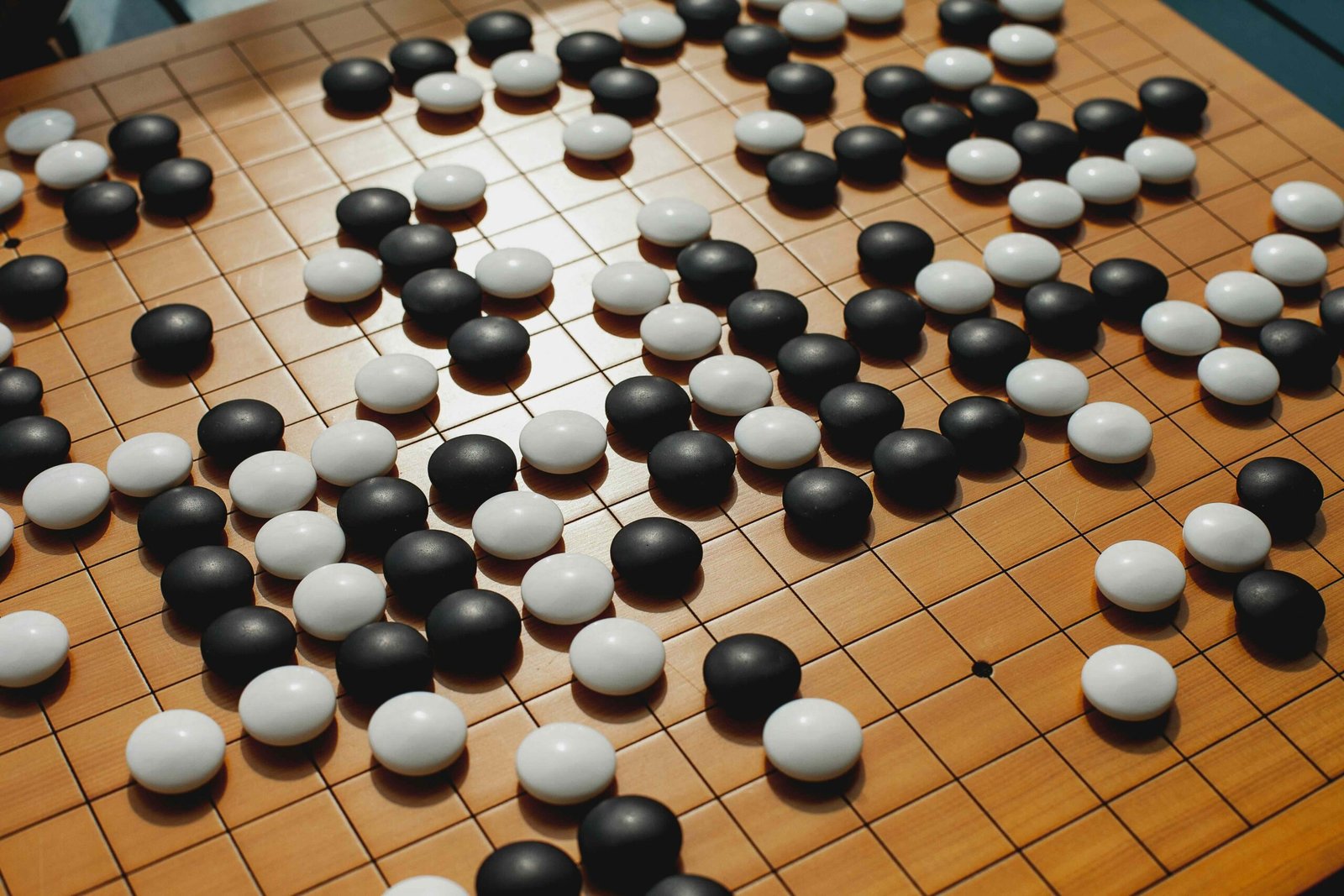
The Big Go Tournament | An English Reading Lesson for Young Learners
Warm-Up
When did you start playing Go?
Who taught you how to play?
How often do you play?
What do you enjoy most about Go?
Do you prefer playing online or face-to-face? Why?
What makes someone a good Go player?
Vocabulary
Strategy – A careful plan to achieve a goal.
Example – Ethan changed his strategy after losing the first game.
Concentrate – To focus your attention carefully.
Example – Good Go players must concentrate during every move.
Patient – Able to stay calm while waiting or working carefully.
Example – Ethan was patient and waited for the right time to attack.
Tournament – A competition where many people try to win.
Example – Players from many schools joined the Go tournament.
Confident – Feeling sure that you can do something well.
Example – Ethan felt confident after practicing every day.
Reading
Ethan’s Biggest Go Tournament
Ethan loved playing Go after school. Every week, he practiced with his best friend, Ray. They enjoyed trying new strategies and learning from each other. Sometimes Ethan won, and sometimes Ray won, but they always had fun and became better players.
One day, Ethan’s school announced a city-wide Go tournament. More than one hundred students from different schools would compete. Ethan was excited, but he also felt nervous because many of the players had much more experience.
For the next two weeks, Ethan practiced every evening. He studied famous Go games, solved difficult puzzles, and asked his coach for advice. Ray practiced with him almost every day. They talked about different strategies and helped each other improve. Ethan learned that staying patient and concentrating on every move was just as important as making clever plays.
On the day of the tournament, Ethan won his first three matches. His final opponent was an older student who had won the tournament the year before. The game lasted almost an hour. Both players thought carefully before every move, and nobody wanted to make a mistake.
In the end, Ethan finished in second place. At first, he felt disappointed. Then his coach smiled and said, “A great player is always learning.” Ethan realized that the tournament had made him a stronger player. He thanked Ray for all the practice, and together they promised to train even harder for next year’s competition.
Reading Comprehension
Multiple Choice
1. Who did Ethan usually practice Go with?
a) His brother
b) Ray
c) His teacher
2. Why was Ethan nervous about the tournament?
a) He forgot the rules.
b) Many players had more experience.
c) He did not bring his Go board.
3. How did Ethan prepare for the tournament?
a) He watched television every day.
b) He practiced, solved puzzles, and asked his coach for advice.
c) He only played one game.
4. How long did the final match last?
a) About ten minutes
b) About thirty minutes
c) Almost an hour
5. What lesson did Ethan learn?
a) Winning is the only important thing.
b) Great players continue learning and improving.
c) Go is too difficult to enjoy.
True or False
Ethan practiced with Ray every week. ______
More than one hundred students joined the tournament. ______
Ethan won every match in the tournament. ______
Ethan’s final opponent had won the tournament before. ______
Ethan wanted to practice even harder for next year. ______
Discussion Questions
Why do you think Go is popular in many countries?
Which is more important in Go: strategy or experience?
How do you feel before an important competition?
Have you ever lost a game but still learned something?
What advice would you give to someone who wants to learn Go?
Speaking Challenge
Imagine you are playing in a very important Go tournament. Tell the story using these sentence starters. Try to use 6–8 complete sentences.
First…
Before the game…
During the match…
After that…
Finally…
Bonus Challenge
Now teach your teacher! Pretend your teacher has never played Go before. Explain:
How do you win a game of Go?
What is the most difficult part of Go?
What is your favorite strategy?
What advice would you give a beginner?
Use as many details as you can.
-
When “Fine” Doesn’t Mean Fine | English for Beginners
Vocabulary Greeting – A friendly word or action when you meet someone. Example – “Hello! How are you?” is a common English greeting. Honest – Saying what is true and real. Example – He was honest with his friend and told him he was feeling stressed. Polite – Behaving in a kind and respectful way….
-
Can Video Games Teach Useful Skills?
Vocabulary Strategy – A plan for achieving a goalExample – Many games require strategy and careful decision-making. Cooperation – Working together with other peopleExample – Online games often encourage cooperation between players. Reaction time – How quickly someone responds to somethingExample – Action games can improve reaction time. Problem-solving – The process of finding solutions…