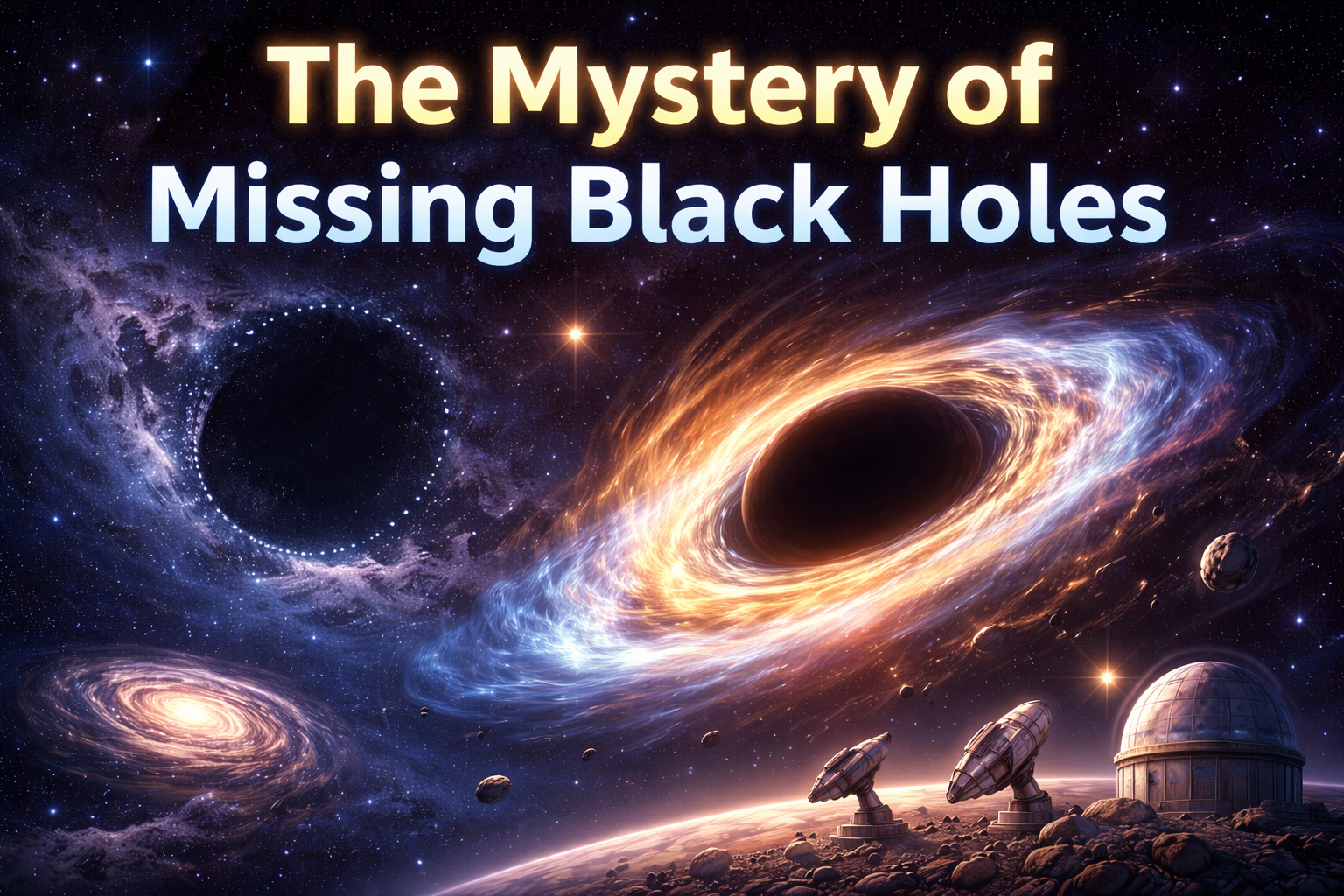
A Black Hole That Should Exist…But Doesn’t
Vocabulary
gravitational related to the force of gravity
detect to discover or notice something using tools or data
collapse to fall inward or break down suddenly
theory a scientific idea used to explain how something works
Article
For many years, scientists believed that when a very large star dies, it must turn into either a neutron star or a black hole. But new data from space telescopes has shown something strange: there are far fewer medium-sized black holes than physics predicts.
Recently, astronomers used gravitational wave detectors and star-motion data to search for black holes that are between 100 and 100,000 times the mass of the Sun. These black holes should be common but most of them are missing.
One explanation is that these black holes are hidden. They do not glow, and they are not pulling in gas, so telescopes cannot see them. Another idea is more radical: maybe stars do not collapse the way scientists thought, and some large stars may explode in ways that destroy the black hole before it fully forms.
This discovery forces scientists to rethink how gravity works under extreme conditions. It also affects how galaxies grow, because black holes help control how stars form inside galaxies.
Right now, scientists are designing new telescopes and detectors that will be able to “see” these invisible objects by how they bend space and affect nearby stars.
Discussion
- What type of black holes are missing?
- Why are they hard to detect?
- What two explanations do scientists have?
- Why does this matter for understanding galaxies?
- What new tools will help find them?