Could Light Therapy Protect Athletes’ Brains From Injury?
Level: Advanced
Vocabulary
Inflammation – swelling or irritation in the body, often part of how it responds to injury.
Example – Researchers found that untreated football players showed widespread brain inflammation by the end of the season.
Placebo – a fake treatment given to a control group so researchers can compare it with the real treatment.
Example – Half of the players in the study received a placebo device instead of the real light therapy.
Wavelength – the distance between repeating points of a light or sound wave, which determines its type or color.
Example – The device used a specific wavelength of red light believed to reach the brain’s outer surface.
Cognitive – related to thinking, understanding, and processing information.
Example – Players who received the therapy also showed better cognitive performance on attention tests.
Skeptical – having doubts about whether something is true or will work.
Example – Some scientists remain skeptical and want to see the results repeated in a larger study.
Could Light Therapy Protect Athletes’ Brains From Injury?
Every football season, players absorb thousands of small hits to the head. Most never cause a diagnosed concussion, but researchers have grown increasingly concerned about the cumulative effect of these repeated impacts on the brain over time. A new study from the University of Utah, published in the Journal of Neurotrauma, is testing an unusual possible solution: red light.
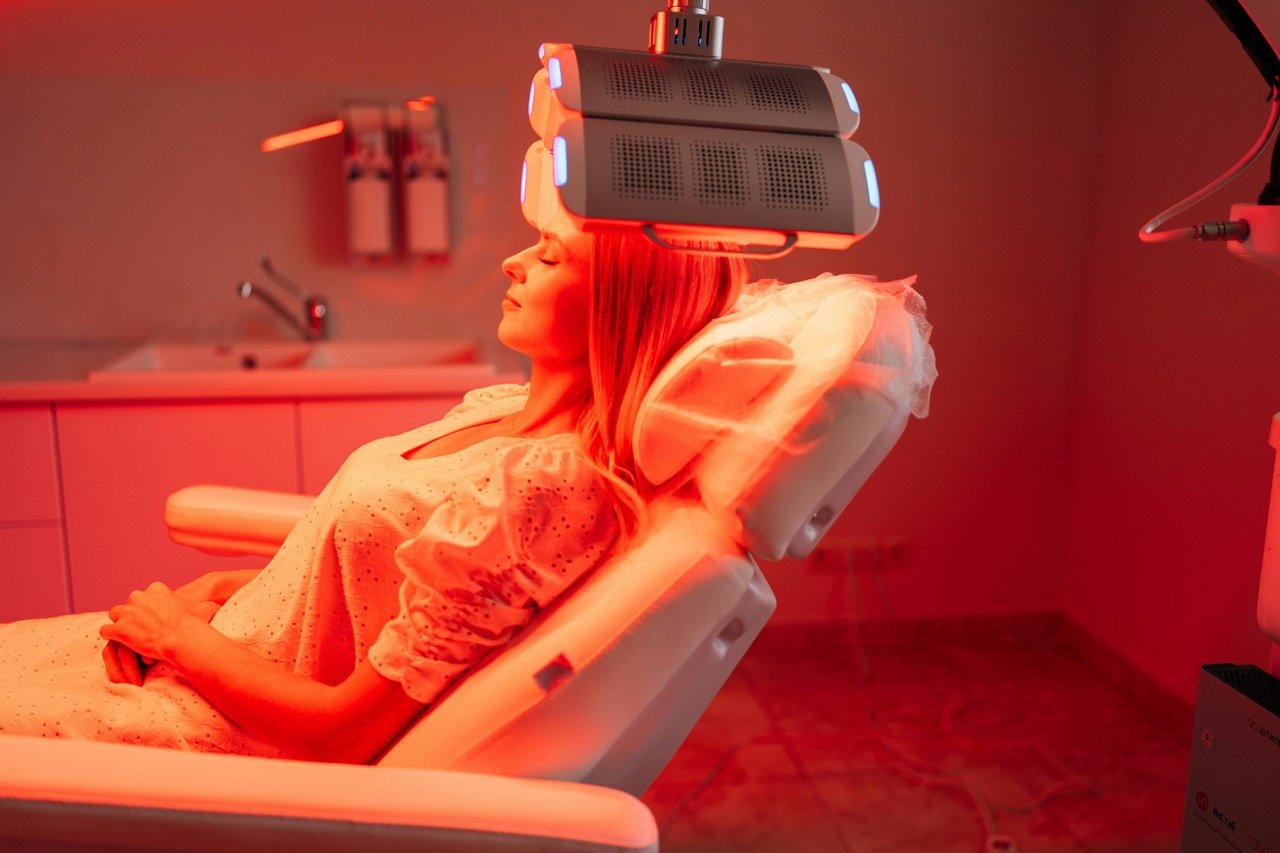
The study followed 26 college football players from Brigham Young University over a full 16-week season. Half of the players wore a light-emitting headset and nasal clip, made by a company called Vielight, three times a week for 20-minute sessions. Using a specific wavelength of near-infrared light, the device is designed to reach the brain’s outer surface. The other half of the players used an identical-looking device that did not actually deliver active light, acting as a placebo.
At the end of the season, the two groups looked very different on brain scans. Players who received the placebo device showed a significant, widespread increase in brain inflammation, a sign of ongoing stress on brain tissue from repeated impacts. Players who received the real light therapy, however, showed no comparable rise in inflammation across nearly all brain regions. In some areas, inflammation in the treated group actually appeared lower than it had been at the start of the season.
“That’s how striking it was,” said Hannah Lindsey, the study’s lead researcher, describing the difference between the two groups. Beyond the brain scans, players who received the treatment also reported fewer symptoms of depression, anxiety, and stress over the course of the season, along with better performance on tests of attention and executive function, the mental skills involved in planning and self-control.
The idea behind the treatment is not entirely new. Photobiomodulation, the scientific name for using light to influence biological processes, has been studied for years in smaller trials, mostly involving patients recovering from a single traumatic brain injury rather than the repeated, lower-level impacts football players experience over a season. Researchers believe the near-infrared wavelength used in the device may help calm inflammation-driving molecules in brain tissue, though the exact mechanism is still being studied.
Elisabeth Wilde, co-director of the university’s Traumatic Brain Injury and Concussion Center, was careful to describe the findings as promising rather than proven. Definitive clinical trials, she noted, have not yet been run, and much broader research and validation will be required before doctors could recommend the therapy for widespread use. Some scientists outside the research team remain openly skeptical, pointing out that this was a small study of just 26 athletes, and that the treatment and placebo groups happened to show slightly different inflammation levels even before the season began, purely by chance.
To address these concerns, a much larger trial is now in the planning stages. Funded by the U.S. Department of Defense, the follow-up study will involve around 300 participants, a scale that researchers hope will settle the question of whether the early results hold up. Until then, the current findings are best described as an encouraging early signal rather than a green light for teams to start handing out light therapy headsets.
Still, the potential implications are significant. Concerns over repeated head impacts in football have grown considerably in recent years, contributing to debates over rule changes, equipment design, and even whether young children should play tackle football at all. A low-cost, non-invasive tool that could meaningfully reduce brain inflammation during a season, if the results are confirmed at a larger scale, would represent a genuinely new approach to a problem that has so far resisted easy solutions.
For now, researchers describe the treatment plainly: not a cure-all, and not something to rely on as a substitute for reducing dangerous hits in the first place. But as one of many possible tools for protecting athletes’ brains, it has, in the words of the research team, earned the right to be studied further.
This is not the first time light-based treatments have been explored for brain injuries. A randomized trial published in JAMA Network Open tested a similar helmet-based light therapy on 68 patients with moderate traumatic brain injury, starting treatment within 72 hours of the injury. That study found no safety concerns, and brain scans showed the treatment produced measurable changes in the brain’s white matter three months later. Patients who received the light therapy also reported somewhat lower post-concussion symptoms, though that particular difference was not large enough to be statistically conclusive in a trial of that size. What makes the football study notable is that it looked at repeated, lower-level impacts over an entire season rather than one serious injury, a pattern much closer to what athletes in contact sports actually experience year after year.
Discussion
Would you be willing to try an experimental treatment like this if you played a contact sport? Why or why not?
Why do you think it’s important for scientists to test a treatment on a large group of people before recommending it widely?
What other sports or activities do you think carry a similar risk of repeated, smaller injuries?
Do you think professional sports leagues do enough to protect players’ long-term brain health? Why or why not?
If this treatment is proven to work, should it be required for all contact-sport athletes, or optional?
What would it take to convince you that a new medical treatment is safe and effective?
Should children be allowed to play contact sports like tackle football? Why or why not?
Sources
University of Utah Health: Near-Infrared Light Therapy Shows Promise for Protecting Football Players’ Brains
JAMA Network Open: Effect of Transcranial Low-Level Light Therapy vs Sham Therapy Among Patients With Moderate Traumatic Brain Injury