Why Do People Float Baskets on Water to Let Go of Bad Feelings?
Vocabulary
Krathong – A small floating basket or boat, often made of banana leaves and decorated with flowers, candles, and incense.
Example – Many families make a krathong together before they take it to the river.
Goddess – A female being that people worship or respect as holy.
Example – During Loy Krathong, people thank the water goddess for the rivers that give them life.
Biodegradable – Able to break down naturally in the environment without causing long-term harm.
Example – City officials ask people to choose a biodegradable krathong instead of one made of foam.
Offering – Something you give to a god, spirit, or sacred place to show respect or thanks.
Example – A krathong with flowers and a candle is a kind of offering to the water.
Lantern – A light inside a protective cover of paper, glass, or other material.
Example – In Chiang Mai, people release paper lanterns into the night sky during Yi Peng.
Article
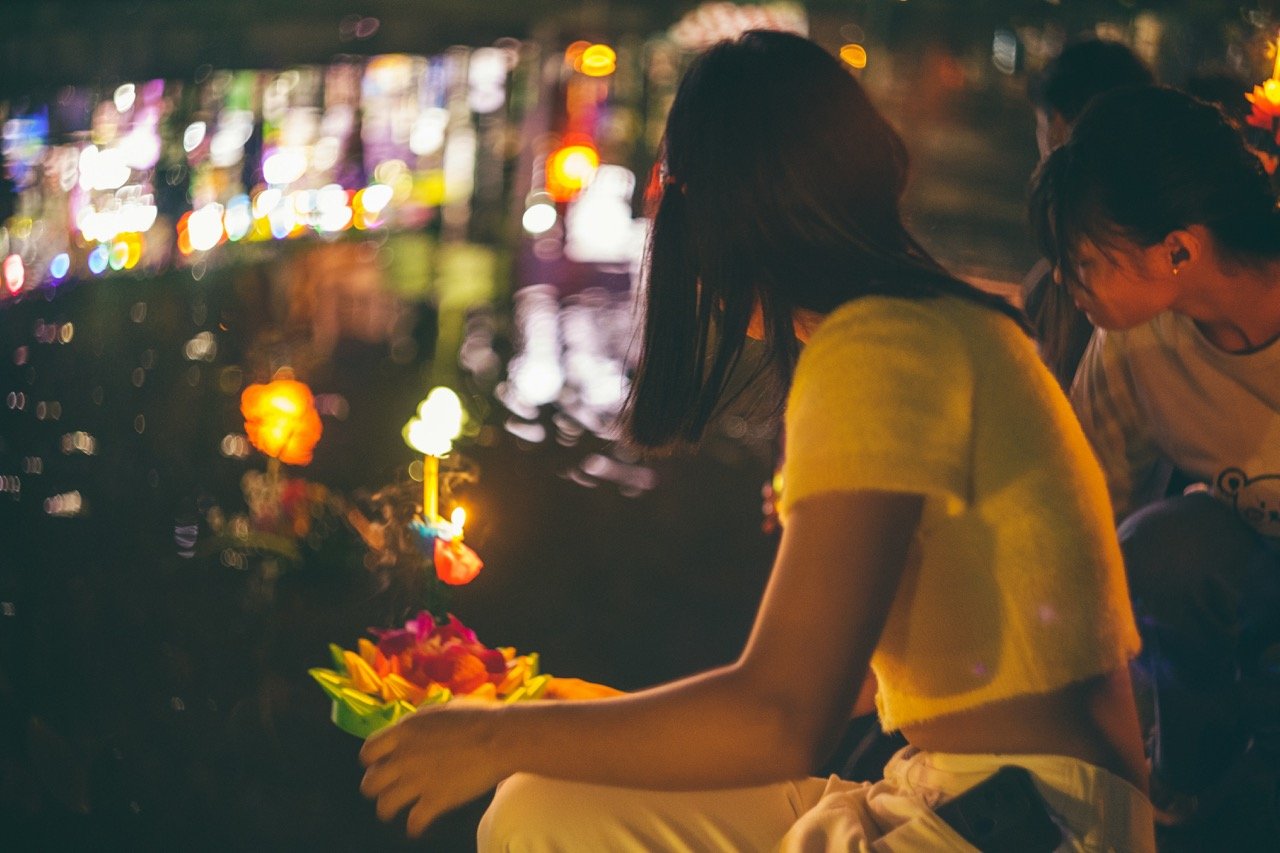
Every year, on the night of a full moon in late autumn, millions of people in Thailand walk to rivers, lakes, and canals carrying small, beautiful baskets. They light a candle, make a wish, and gently place the basket on the water. This is Loy Krathong, one of the best-loved festivals in the country. “Loy” means “to float,” and “krathong” means a basket or small boat. In 2026, the festival falls in the last week of November. Some sources, including eSIMPass and UmeTravel, give different dates (November 24 or 25), because the festival follows the full moon of the twelfth month in the Thai lunar calendar. Anyone planning to attend should check the final date with local authorities.
The central idea is simple but powerful. According to Thailand Highlights, people float krathongs to let go of negative feelings, to thank the water spirits, and to hope for good fortune in the coming year. Many people add a coin, a strand of hair, or a fingernail clipping to the basket. Some say this carries away anger or bad luck. Others simply enjoy the quiet moment by the water with family and friends. The meaning can be spiritual, cultural, or personal, and different people see it differently.
The festival has deep roots. According to UmeTravel, it is more than 700 years old and is linked to the Sukhothai Kingdom. A popular legend says a court lady named Nang Noppamas made the first krathong during the reign of King Ramkhamhaeng. The same source explains that the festival mixed older Brahmin rituals honoring Hindu deities with Buddhist traditions, and that it later became a way to honor the water goddess, Phra Mae Khongkha. Because the story is a legend, historians may disagree about details, but the link to Sukhothai remains strong. The Tourism Authority of Thailand’s official portal, thailand.go.th, still promotes a large Loy Krathong show at Sukhothai Historical Park, scheduled for November 15 to 24, 2026, with tickets priced from 500 to 1,200 baht.
In northern Thailand, the festival has a second form. In Chiang Mai, Loy Krathong happens at the same time as Yi Peng, when people release paper lanterns into the sky. UmeTravel lists Yi Peng for November 24 and 25 in 2026. Both traditions are about letting go, but one uses water and the other uses air. Visitors often say the sky full of lights looks magical. However, UmeTravel also reminds readers that rules about sky lanterns can change from place to place and from year to year, so travelers should ask local authorities before they release one.
Alongside the beauty, there is a real environmental question. What happens to hundreds of thousands of baskets after the candles go out? Bangkok shows the scale of the issue. According to Bernama, city workers collected 391,027 krathongs from rivers and canals after the 2025 festival, which was 24 percent fewer than the 514,590 collected the year before. Bernama also reported that about 82.76 percent of the 2025 krathongs were made from natural materials, while 7.23 percent were foam and 10.01 percent were bread. Natural krathongs were shredded and turned into organic fertilizer, according to the same report, while other materials went to landfill.
The numbers suggest people are changing their habits, but experts say the problem is not fully solved. Foam does not break down well, and Khaosod English reports that such materials can turn into microplastics in the water. Bread seemed like a clever answer, because it is natural, but officials say it has its own risks. Khaosod English quotes Surin Vorakitpornkul, director-general of Thailand’s Pollution Control Department, who warned that bread krathongs become food waste in the water. The Bangkok Post reports that the Bangkok Metropolitan Administration asked residents to go “zero-foam” and noted that 6,800 bread krathongs released at one park were followed by polluted water and dead fish. The same article says the city also discouraged metal parts in krathongs because they make cleanup harder.
Officials and writers have suggested several alternatives. Khaosod English lists banana leaves, lotus flowers, and ice krathongs that melt away. It also suggests sharing one krathong among several people, using the official floating areas where cleaning crews work, and even floating a krathong online. The Bangkok Post notes that the city offers an online option at greener.bangkok.go.th, with games and prizes. These are official recommendations, and people can decide for themselves which ones feel right for them.
Does a digital krathong feel the same as a real one? That is a matter of opinion. Some people may feel that touching the water is an important part of the ritual. Others may feel that the meaning of letting go and giving thanks matters more than the object. Many people probably find a middle path, such as a small natural krathong made by hand. We cannot say for certain how the festival will look in ten years, but the recent trend toward natural materials suggests that the tradition is adapting rather than disappearing.
Tourism is part of the picture too. Events such as the Sukhothai show attract visitors from many countries, and for many travelers the festival is a first meeting with Thai culture. This can bring income to local communities. It can also mean larger crowds and more waste, which is one reason cities provide designated places and cleanup teams. In the end, Loy Krathong asks a gentle question that people everywhere can understand. What would you like to release, and how can you do it while taking care of the place you live in?
Discussion
What feelings or worries would you want to let go of if you were holding a krathong by the water?
How do you think a festival can keep its meaning when its customs have to change to protect the environment?
What are the advantages and disadvantages of floating a krathong online instead of in a river?
Which festivals or traditions in your country involve water, light, or fire, and what do they mean to the people who take part?
How should local governments balance tourism income against crowds and waste during a popular festival?
Why might a natural material such as bread still cause problems when thousands of people use it at the same time?
What small habit could you change in your own life to celebrate a tradition in a more eco-friendly way?
Sources
Tourism Authority of Thailand (thailand.go.th): Loy Krathong, Burning Candles, and Playing with Fire Festival in Sukhothai
Bernama: Loy Krathong Festival (Bangkok krathong collection figures, 2025)
Khaosod English: Thailand Urges Eco-Friendly Loy Krathong Practices
Bangkok Post: BMA calls for ‘foam-free’ festival
Thailand Highlights: Loy Krathong Festival 2026: Date, Meaning, Traditions
UmeTravel: Thailand Lantern Festival 2026 and 2027: Loy Krathong and Yi Peng
eSIMPass: Loy Krathong 2026: Dates, What to Expect and Staying Connected